Article
Diffuse to normal map tools: what they can infer, and when you still need a sculpt or bake

Tangent-space normals encode high-frequency detail. Image-driven estimates can be useful starting points, but they are not a substitute for authored geometry everywhere. Here is an honest workflow split.
Last updated: April 2026. This article describes common authoring tradeoffs; it is not a substitute for your engine’s normal map import rules.
What “diffuse to normal map” usually means
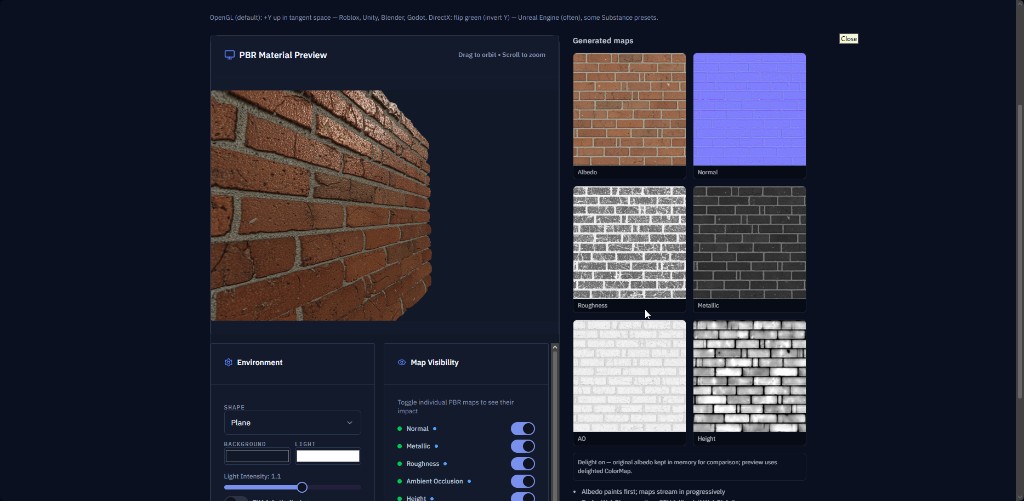
Queries like diffuse to normal map, normal map from diffuse, and normal maps online often describe the same workflow: estimate surface orientation from color variation in a photograph or hand-painted albedo. That can work when:
- The plate encodes relief-like shading cues (self-shadowing, lighting variation) that correlate with geometry you want to exaggerate.
- You accept that the result is a stylization or starting point, not a physically faithful capture of a complex sculpt.
It is weaker when the plate is flatly lit, heavily compressed, or when you need hard surface accuracy for manufacturing-adjacent assets.
When a sculpt or bake is still the right answer
High-frequency silhouette-changing detail (deep cracks, undercuts, bolts) generally needs meshes or displacement in source content, not only a normal map inferred from color. Many pipelines:
- Author a mid-poly sculpt
- Bake tangent normals and height to low-poly UVs
- Use photograph-driven tools only for tertiary skin or tile breakup
GenPBR entry points (for matching search intent)
GenPBR maintains dedicated URLs that match how people search:
The interactive workflow lives at /generate. If you are comparing tools for normal maps online, evaluate seam behavior, tangent basis consistency with your target engine, and whether you can iterate without destructive reimports.
Related
- Image to PBR, broader plate-to-material framing
- Roughness map generator, normals rarely ship alone in metal/rough
Honest SEO should not promise “one click replaces ZBrush”, it should route readers to the right next step in their pipeline.
About Star
GenPBR is a professional tool for generating PBR textures using industry-leading algorithms. Create photorealistic materials for games, architecture, and 3D art with proven techniques for Unity, Unreal Engine, Blender, Maya, and Roblox.